15 May 2012

Grand Canyon

Finally, no need to rent a car to get to the Grand Canyon. A shuttle took me there from Flagstaff (150 km/100 mi away) where I stayed at Henry's. I think I should help locate us. The Grand Canyon is located in northern Arizona, neighbouring state of California and Nevada. And who says canyon, says river in the canyon. Who would have guessed that the Colorado runs through the Grand Canyon?

From Flagstaff, the road goes up to reach the Colorado Plateau, a vast and flat region, larger than the United Kingdom and Ireland combined, which covers the States of Colorado, Utah, Arizona and New Mexico.

Click on map to enlarge

So here I arrived at the gates of the Grand Canyon National Park. But I still couldn't see anything. I pitched my tent because there were a lot of people, despite the early hour, and I didn't want to hear that the only campsite at thirty miles around was fully booked. The excitement grew since I am now heading to the Rim. I will not see anything until I reach the rim.

And then, suddenly, everything appears under my eyes. Like everyone, I am amazed by what it is considered to be: nothing but a gigantic hole in the ground. The majesty of it resides in its dimensions. The Canyon deserves its adjective Grand. The opposite rim is 15-20 km as the crow flies (about 10 miles). In some directions, we see more than a hundred miles around, but do not have an overview of 450 km of the Canyon. And the bottom of the canyon is 1500 meters below us. It's so cashed we can hardly see the river.


But obviously, like everyone else, I also arrived with my own representation and images of the Grand Canyon. And ultimately, it did not fit quite the reality. Here, for three reasons: visibility, colours and chaotic.
1. Visibility, because there is always a sort of veil, due to pollution coming from Southern California (to the West) or sometimes New Mexico (to the East).
2. Colours, because when I arrived on the edge for the first time during the day, there is virtually no shade and the sun is hitting the stones, giving them a uniform gray color - so as to other times of the day, you can admire the whole range from red to green through the ocher and gray.
3. Chaotic, finally, because the Canyon has not eroded uniformly across its width, knowing that in addition, rivers flowing into the Colorado have also contributed to create side-canyons.

So I made the necessary settings on my camera (contrast, brightness and saturation) for optimal shots.


When you see that, we easily understand that the Canyon is subject of much attention. The United States made it a National Monument in 1908 and then a National Park in 1919. And 60 years later, in 1979, the Grand Canyon is among the first World Heritage sites listed by the UNESCO. More than 400 Park Rangers ensure its preservation and welcome some 4.5 million people who, like me, will visit the Grand Canyon in 2012.

I spend my first day on the Canyon rim, hiking to several different viewpoints. This place is really fascinating. But I felt that I might experience more interesting stuff if I was hiking in the heart of the Canyon. I went to the backcountry information centre. Twenty minutes later, I came out with my special permit and my reservations for overnight camping. The day after I left for three-day hike.

When you stay on the edge, it changes its point of view horizontally, of course. But actually, going down offers a totally different perspective. The first image that came to mind is that of sand through a giant colander. Do not tell me that I am the only one fascinated by the slow flow of sand beach in a colander and patterns that appear gradually.

The descent is steep at first. Thank God, I'm not sensitive to the height and vacuum. Then the slopes are less steep, then steeper again. And so on according to the rock layers that we are crossing. Let's break a few moments, the time to quickly tell the story of the Canyon.

Basically there are two billion years, began a process of sediment deposition in different layers, of different composition, on what was then submerged by the ocean. Then, about 65 million years ago (when the last dinosaurs were dying), what is now the Colorado Plateau rose water, to over 2000 meters (6,000 ft). I'll spare you the theory of plate tectonics, convection and continental drift. And I jump up until 5 million years ago. There, the Colorado begins eroding the plateau of the same name and digging the Grand Canyon in the south. The rocks are of different composition, alternating softer or harder layers, erosion (due to the river, but also to rain and frost cracking the rock) makes some parts steeper than others. And thus reveals layers of different colours. From top to bottom, we find limestone, red rock (strong presence of oxidized iron, rust after all!), green rock, sandstone, limestone, and finally, schist. It has a scale of time since the rocks at the bottom of the Canyon date back 1.7 billion years, while those at the top, 230 million years.


Returning to our oven. Yes, indeed it is hot in the Canyon. The temperature is 20°-25°C (70°-80°F) up with a fresh breeze, but it rises above 35°C/95°F when you go down. And all this of course when you have the chance to find shade! Given the environment, few people venture on a hike in the Canyon. I almost want to say "good!" But there are all kinds of wildlife. These range from lizards to squirrels, from mule-deer to California condors reintroduced recently.

The view is breathtaking up the last part (the schist if you followed). It is steep, 500 meters (1500 ft) above the Colorado. Too bad for those who have vertigo and can not enjoy this magnificent view. Personally I really enjoyed it! (videos available in the previous article)

At the bottom, it passes through a tunnel that leads to a bridge over the river. The trail leads quickly to Colorado that seems peaceful and attractive. But no! Impossible to swim. The currents are deadly, and the water freezing cold anyway. So I fall back on a tributary, where is my campground. I bathe in the middle of deer grazing in the open camp. Pending, squirrels were attacking my little bag fiercely, trying to reach the mixture of nuts that they had felt. Now I'll never forget to put all my food in iron containers provided for this purpose, as they are for bears in Yosemite.


While walking in the afternoon along the Colorado, I saw a big box, by the trail. I laugh so hard when I read the message probably left the close-to-burnout FedEx guy: "Enjoy this! As of June 1st we will NOT deliver mail anymore!". Obviously he has not thought about using a mule to go down into the Canyon.

What I like about camping is that I hold much more naturally to the rhythm of the sun. Up early, sleep early. It feels great and allows you to walk in the morning when it's cooler. Second day, I began the ascent. Not too complicated, I stopped halfway up to the second camp. There I met Alex, a French who makes a road trip across the United States. Nice guy, nice meeting. We watched the sunset over the cliffs of Plateau Point. I think this is the best place in the Canyon: the tumultuous river 500 meters below our feet, and the canyon rim 1000 meters above us. We are literally in the middle of the canyon. By late afternoon, the rocks are different colours. You must love the red! We have the whole palette.

The next day I went back to the top with Alex before he resumes his way to Las Vegas and the California coast. I stayed an additional 24 hours. I met Robb, a Park Ranger, inexhaustible on the history and geology of the Canyon. In the evening I attended a beautiful sunset to conclude in beauty those few magical days.


13 May 2012

6 May 2012

Lights of Las Vegas

It feels slightly frenetic at the approach of this looming city. It's there, in the distance. We were approaching, after several hours driving through the desert, crossing small towns only twice. And the closer you get, the more traffic intensifies in Friday night where cars left from Los Angeles are starting to catch our bus.

I have long been reluctant to step in Las Vegas. I was afraid of being quickly sickened by this large city, nicknamed “Sin City”, only ruled by money and entertainment of all kinds... So much so everyone stop feeling guilty for all its excesses by saying: “What happens in Vegas, stays in Vegas!”. And then I let myself be convinced by some to go and judge by myself. After all, it is on the way to Grand Canyon, so it's not as if I were a big detour.

Thinking about how I would describe Vegas, the first image that came to me is that the board game we have in France: Hotel. I do not know if many know it, but that's exactly right, life size. Las Vegas is a huge playground, covered by hotels in thematic architecture, where visitors are great kids who only think about playing and having fun, all in a joyful and carefree atmosphere.


The urge to play didn't overwhelmed me. I did not have to fight to avoid unnecessarily depleting my limited budget. The sirens of roulette, poker, craps, blackjack, slot machines had no effect on me. However, I let myself be lead by Sally (my host, also dealer at the prestigious Bellagio) in dizzying roller coaster of New York and the Big Shot at the top of the Stratosphere Tower (one that looks like an ice cream with an antenna on top). Basically, the car is driven for 50 meters along the antenna and down in free fall, all at 1,000 ft / 330 m altitude (slightly more than the Eiffel Tower). Thrills guaranteed!

I walked the Strip day and night. The Strip is a portion of Las Vegas Boulevard of nearly 7 km (more than 4 mi) and includes all the major hotels-casinos in the city: Bellagio, Paris, Caesars Palace, Mirage, Venetian, Monte Carlo, New York, Excalibur, MGM Grand, Luxor and Mandalay Bay to name the most famous. The city has hundreds of casinos. There are even slot machines in supermarkets, between the newspapers and the drugstore.


All this does not make you forget that we are still in the middle of the desert at 600 meters (2,000 ft). It is very hot and very dry. Man dehydrates in no time. Precisely, water is a particularly tangible issue. The main resource is the vast Lake Mead, east of the city, where the Hoover Dam on Colorado waters contains the tumultuous river and supplies water to southern Nevada, South California and Arizona. But the combined effect of increased consumption and global warming makes people fear of a complete drying within 10 years of the largest reservoir in the United States, now six times as large as Paris.

So I took the pleasure to discover this very special universe and unrivaled in the world. I also learned the tragic consequences has been the subprime crisis of 2008 (Las Vegas was one of the most affected cities in the US). I saw behind the scenes some neglected neighborhoods. I was finally not disgusted by big money (which we don't see – everything is in the form of tokens or gain receipts). And ultimately I made the most of Marco and Sally, and then Michele, my great hosts out there.


4 May 2012

Yosemite before desert

Two photo albums. Two different atmospheres. Two different climate schemes.

The Yosemite National Park, created in 1890, is the second oldest in the US after the Yellowstone NP. The Park owes a lot to John Muir, naturalist in the 19th century.

Even if the park is 3,000 km² large (760,000 acres), only 1% can be visited. The rest is designated “wilderness”. Man can already be in admiration of Mother Nature in the Yosemite Valley, in the centre of the Park, where we find El Capitan and Half-Dome, the two most popular features.

The narrow valley is surrounded by granitic cliffs. The coniferous forest and vegetation give a perfect habitat to deers, bears and other felids. Numerous water falls complete this magnificent green and grey scenery.

In the middle of this majesty, I felt very small and humble. You can also feel serenity in the valley. Visually, everything seems in harmony. Deers are not afraid of people, squirrels seem to have a lot of fun, bears are not so threatening when food is away!

I camped there two nights before I hit the road again since rain was being persistent.


Then I took the direction of Las Vegas. Leaving Central California, you enter the Mojave desert. Even if I've never been there, scenery reminds the Moon. The colour is more orange though. And you find cactus and bushes. It's a completely other world, where you feel the hostility of the environment.

It's extremely dry. You need to drink a lot (of water). Noose bleeds daily. And cities are scattered, distant and lost in the immensity.

Thanks to Marco and Sally who hosted me for almost a week, I could see the Valley of Fire. The name is self explanatory when you see the pictures...


1 May 2012

Day 100

100 days also means:
  • 3 months and 8 days
  • 10,270 km or 6,381 miles (flight Paris-Fairbanks non included)
  • 253 hours in transport, meaning 10 and 1/2 days non stop
  • 7 US States (Alaska, Montana, Idaho, Washington, Oregon, California et Nevada) and 2 Canadian provinces (British Columbia and Alberta)
  • 7 means of transport (hike, car, ski, train, ferry, bus, bike)
  • 52 drivers who gave me a lift
  • 38 different accommodation
  • 4,329 pictures taken
  • 83°C / 148°F of difference between Fairbanks (minimum at -49°C/-55°F) and Las Vegas (maximum at +34°C/+93°F)
  • 1 proxy voting
  • 1 McDonalds only
  • More than 2,000 visits on the blog: thank you all!

100 days also mean:
  • thousand faces and people met
  • great surprise when I'm invited by people instead of camping
  • true emotion in front of people's kindness and generosity, or in front of stunning landscape
  • decisions to be made daily on the road to take
  • hours of enriching discussions
  • moments of doubt and questioning
  • simple joy and real fun with people, especially when there is a good vibe between us
  • days when I wish I had travelling companions
  • apprehension of the unknow cleared up when I landed in Alaska
  • daily learning about life.

28 April 2012

Race Info

Day 97 – Kilometre 10,030 (Mile 6,232)

Done! 10,000 kilometres covered (6,214 miles). I crossed this symbolic line not very far from Las Vegas, in the heart of Mojave desert. After 240 hours spent in train, ferry, bus, on foot, hitch-hiking (including waiting time), I have an average speed of 41 km/h, meaning 25 mph.


I spent 10 days in San Francisco. The first 5 days I essentially rested at Laurence and Chris', and their two daughters Victoria and Aldora. A Frenchy and friendly atmosphere to reload my batteries. The next 5 days, I stayed at Jeremy's (greatest cook ever!) with two Danish co-travellers. We explored the city from A to Z. I guess I'd quicker list the places we didn't go to.

Then I spent two days in Yosemite National Park. The rain didn't allow me to stay more. But the place is spectacular. I hope the pictures can show that.

Distance: 1,250 km (775 miles)

I continued eastward. Hitch-hiking didn't work that well in South California. I had to take the bus to reach Las Vegas. I'm not that much a gambler, but it should be an interesting place to see. And anyway, it is the gateway to Grand Canyon. I'll stay at Marco and Sally's, a lovely Franco-American couple, friends of friends of Mike and Eve's (who hosted me on the coast couple of weeks ago).

I left home more than three months ago. And I recently realised that what I missed the most was my pair of jeans. I know, it might sound a bit superficial... I keep wearing (and washing obviously!) the same clothes. Due to equipment constraints, my stylish self is far away! I couldn't stand it anymore. Thanks Mum and Laurence who made their most to send my pair of jeans and my red shirt to Las Vegas, via San Francisco.

25 April 2012

San Francisco

Here is the rest of my pictures from San Francisco...


22 April 2012

Golden Gate Bridge

Here are the first pictures of San Francisco. Let's start with a monument: the Golden Gate Bridge (75 years old this year) which I crossed on foot. The first aerial picture was taken during my first stop in January.


18 April 2012

More than a village, a community

Bolinas. It was a name on my road book. It was a confidential suggestion from Lucio (one of the great people I met on the Pacific coast). It was a few decades of struggle against the county to avoid having the signs to the village on the road nearby. But Bolinas has been much more than that!

It all started with a very rainy late afternoon, when I had been forced into a detour of several dozen miles because one of my drivers of the day didin't drop me in the right place (despite my repeated requests...). And there, Mark stops. I no longer believed it was doable. I told him that I was trying to go to Bolinas. He replied: "Get in! This is where I live. " What a godsend!

In the car, we started to discuss. The current flows immediately with this 70 year old man, frankly smiling, curious, Vietnam veteran, traveler in his youth, settled in Bolinas for about 30 years. When I asked him if he knew a few spots to pitch a tent for a couple of nights, he had been already maturing his thoughts for a few minutes. And arrived in Bolinas, he offered me a tour of the village and then took me in his house. I just needed his wife's agreement. But when you see Meg, you suspect she usually agrees about many things.


Bolinas is a village a little isolated. Literally, this is not even on the American continent since the famous San Andreas fault (which causes massive earthquakes) separates the Pacific plate where Bolinas is located and the North America plate on which are the United States.

In the 70s, a bunch of hippies moved there to preserve the small bay (what they call the Lagoon) from an oil spill in San Francisco Bay. And they stayed. When some businessmen began to have plans for this quite and pleasant place, the hippies organized politically to create a true community.

It is this spirit that has endured over the decades. Not that of a closed community of hippies in tie-dyed t-shirts living in Volkswagen vans in which only reigns "sex, drugs and rock 'n roll" as it could be the case in older times. No. It's more a community conscious of how lucky it is to live in a beautiful place, it must preserve and live harmoniously in.


The community does not want to extend beyond measure. Surrounded by state parks, space is limited, access to water difficult. Moreover, it is the latter that determines whether to grant land. This is how the community fought to prevent the construction of a resort, "sorry, but no! We can not have enough water for you! ". End of the project.

Frankly, it's quite fascinating how people who live there feel involved in community life. There is a real sense of belonging, collective vision for their community, mobilization and collective struggle happens ahead of a natural or urban hazard. It's not easy every day but Mark and Meg have assured me that this spirit was being built day by day. Through regular meetings, events, exchanges between people, etc.


Some people work in one of four organic farms in Bolinas, others run a few shops and cafes in the village, others are fishing or working outside Bolinas. Mark and Meg, seeing my interest and curiosity, introduced me to John, a friend of theirs who grows a lot of exotic plants to study biodiversity. Fascinating and enriching.


Mark and Meg have been living there for nearly thirty years. They grow their own garden which allows them to be self-sufficient in fruits and vegetables. They built their wooden house, with a maximum opening to feel almost outside. They make compost. They produce much of their electricity from solar panels and can afford to water their gardens with water collection.

Bolinas is a quiet oasis a few miles from the San Francisco Bay. It can be also seen in the distance. And we appreciate the calm here imagining the turmoil there. Mark and Meg, with their warm and friendly welcome, have been a real nice surprise on my way. They have been a real source of inspiration and reflection. A beautiful conclusion of my two weeks on the Pacific coast, before exploring San Francisco.


16 April 2012

US Pacific coast


Here are pictures taken during the 2 weeks I spent on the Pacific coast of Oregon and North California.

13 April 2012

Great people met on the Pacific coast

A native of Montenegro, a mother on holiday with her son, two laid-back Londoners, two Belgians just graduated. What is the relationship between all these people? None, except that I crossed their paths, along the Pacific coast of the United States.

I knew I would have a lot of fun between Portland and San Francisco. First, because the coast is beautiful, wild, slightly mournful if the weather is less good, very sparsely populated, and very well preserved. But it is also one of those regions of the United States where we meet many very cool people!

There was David, a native of Montenegro. I was hitchhiking at a street corner in Portland and we started to discuss everything from nothing, but mostly rain falling. Finally, he invited me for a coffee at home, explain a better way to reach my next step, prepared my new sign to hitch-hike, and discussed about former Yugoslavia. In the past he met several times and interviewed war criminal Radovan Karadzic (he still calls him Radovan and considers him as a friend).

Janna and Tyler passed me in their car. Five minutes later, they passed me again but then stopped. Vacationing on the coast, they found that I looked trustful and decided to pick me up. Good pick for me since they were as little in hurry as me. So we took some detours, saw a lighthouse, a cape, whales in the distance, hiked a bit before they dropped me off at my hosts', the very ones you “met” in my post about Pacific City.

Seth, another host on the coast, introduced me to his vegetarian cooking skills and beautiful places outside the city. He also let me share nice evenings with his friends of Lincoln City. Without that, I'd bet that this sad city without character would not have left me a ever-lasting impression.

Then Michael, born German, installed in the U.S. for a number of years and with whom I did a little way. A simple life based on surfing and travel. In the coming days, he is taking off to India for few months.

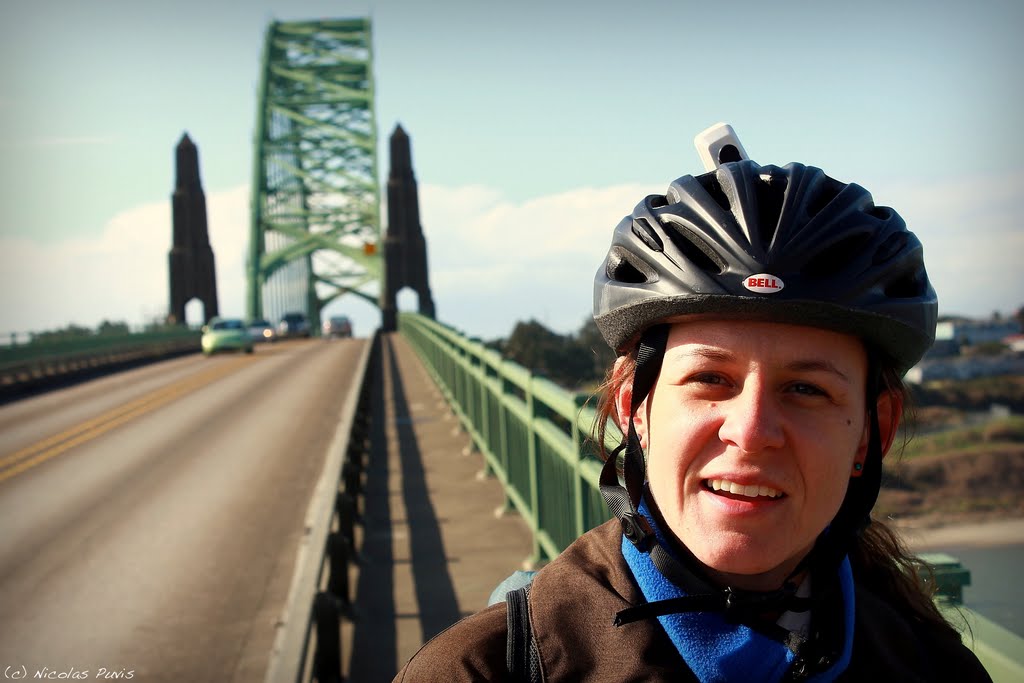
I met Lesanna on a bridge in Newport. One of those big metal truss bridges the American West is full of. I came across the river when we passed one another. Her, pushing her bike; me, backpacking slightly disheveled by the wind. I just advised her to hold her bike in the wind. Apparently I scared her. So we started talking on the bridge, on the pavement, five feet from high speed passing cars. A great traveler, too, we talked about our respective journeys. After that we decided to dine together with her colleague Andy, also a biologist at the Seattle Aquarium. And ultimately, she never bike ride that bridge to go and see the lighthouse on the other side.

It was early that morning. And it rained like never before. Under my poncho to hitch-hike (not much choice!) I knew my chances of success rather slim. But Kirk had mercy. A 20 year old who came home from his night shift. I think he dreamed of traveling when he eventually slept that morning. He already dreamed of that when we were talking about his desires and my journey in his car.

Micah stopped because he didn't see any danger could come from me. It is true that the only idea of wanting to oppose him is in itself a very good joke. So impressive, but so nice. Arrived in Florence, where he worked, he called Christine, his wife, so she could join us and they invited me to lunch. Around a true American hamburger, we talked of France (where Christine lived a few months as a youngster), their six children, Oregon, my journey and their former bison farm.

Usually I'm careful and I "sort" the cars in which I feel I can get ... or not. There were three or four times that I refused politely when I find the person/people a little ... strange. When Lucio pulled over his camper crammed full of clothes, mattresses spilling out onto the front seats, older packages of fast food, and blankets for the dog in the passenger seat, I do not know what crossed my mind but I went up. And finally, Lucio is a great guy. A true hippie, that's all.

That evening, I found a little free camping at Winchester Bay. It must be said, a tent and a backpack consume a lot of water or electricity compared to my neighbours traveling with their motorhomes. I laughed alone of the disproportion between our ways of traveling when Ed asked me if he had not crashed my tent backwards. It would not have been a joke if it was the case! And then everything is chained: drinks with his friend Mike, then Mexican dinner with the occupants of the three motorhomes (a whole bunch of sheriffs with their kids). And the next morning, hot coffee before heading back. That was great!

Gary has also turned around, after discussion with Chris, with whom she returned to Bandon after their groceries. A very cool, long white hair, large sunglasses, which let imagined her in the 70's. So nice, she even insisted on taking me directly to Port Orford offering me a real tour of places I never would have discovered if I had drawn straight.

Arrived at destination, Kathy greeted me with such enthusiasm it reminded me of another great-grandmother I know. We walked on the beach, hiked along the cliff, visited a lighthouse, saw whale sprays off the coast. I have dried my tent in her living room, she made me a delicious breakfast, we hiked again, before she drove me herself to my next step. A great shared moment.

Rob and Dave are two Londoners landed in Oregon twenty years with their parents. They are still there. They take life as it comes, and everything is fine. They live with a bunch of occupations alongside their printing business. Their house in Brookings is an assembly of a thousand things that wacky I never imagined we would ever dare to associate within the same space: a mini-rotary printing, a garland of light Christmas, surfboards, a huge sofa, a bunch of musical instruments, a wall covered with burlap, another with newsprint, a banana tree, and so on.

Outside, Leon was there. I spoke with him for an hour. Very intriguing, Leon (no picture unfortunately). It started with his theory of cataclysmic events (type tsunami or earthquake) guided by humans. A dark power that seeks to increase his power by atomizing some communities a sudden natural disaster. And then there was a whole chorus on climate change. There I still expressed my views. And on 11 September. And others after. But all in good atmosphere.

At the cafe the next day with Dave (pictured above), I met Deanne who offered to drive me to the California border, then to another city. We finally went to her place when she saw my interest in her project of Bed & Breakfast with a garden part. And in the end, she took me to visit the amazing Redwoods, these huge trees along the cylindrical trunk and foliage perched almost 100 meters above the ground.

What happens when two Belgians travel to celebrate the end of their studies? Here is a four or five-month anticlockwise road trip around the U.S. It also gives some smiles when I knew they had struggled to find the Pacific coast, they had lost their spare car keys, they had burnt the battery of the same car because that they had listened to music while falling asleep in it. Travel tales, they do have! And we took our time, we camped, we cooked over a wood fire, we went as tourists would do. And that was great!

Mike offered me to drop me off five kilometres away. I agreed. I told him that I wanted to go to a free camping along the coast. He suggested a place not far from where he dropped me off, as plan B in case no one else would stop. In the end, he came back five minutes after to offer his garden as free camping. A true garden party! And with him and his wife Eve, I spent two very pleasant evenings to cook and talk.

Great encounters. And for those who beg for a picture of me, here you are!

Well, maybe I'll stop here. There were so many others. And there would more than double to write about all dogs, cats, lamas, and other pets I've met but it would be less interesting. You will find all the faces in the portrait gallery on the "Pictures" (and also here below). And for landscapes, wait a few days I arrived in San Francisco to do everything at once.


6 April 2012

Race Info

Day 75 – Kilometre 7,945 / Mile 4,937

Here I am, a couple of miles from California. Brookings is the last town on the Southern part of the Oregon coast. Tomorrow, I'll leave behind this State that I so much appreciated, both for its wonderful wilderness and the quality of people I met. Very soon, details on that with pictures.

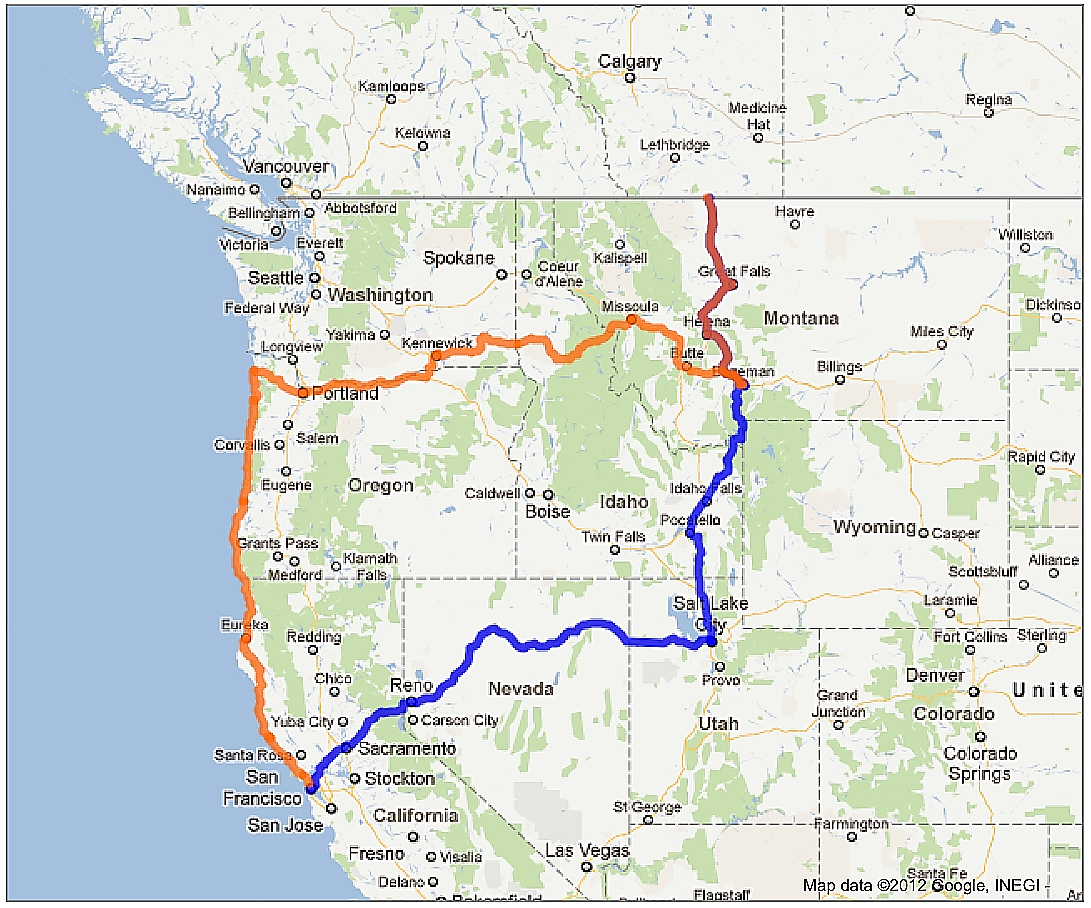
As for today, here is a map. When I prepared my trip, I first thought about crossing Montana from the Canadian border, visiting Yellowstone National Park, following the Rockies until Salt Lake City, and eventually cutting through to reach San Francisco (in blue on the map).

But I changed my mind. Not that I was completely enough of mountains, but I have to admit I like my liberty and to have more options in front of me. But I also knew that Portland, Oregon, and the Pacific coast would amaze me. Instead of choosing between Rockies and Pacific, I chose both! From Montana, in front of Yellowstone which was closed, I went Westward to Portland, then followed the coast Southward until I arrive in San Francisco (in orange on the map).

This option doesn't make that much of difference in terms of distance. And then, after San Francisco? Don't be impatient. I have an idea, which needs to be refined. But please give me tips by commenting on this post!


2 April 2012

Life in Pacific City


Mary and Rob live in paradise. You just have to look out their windows to be convinced. They live in the countryside, on the Pacific coast, along with their two playful cats and their four hens. The landlord, who is also their neighbour, also agreed for a dog. But not for the goat. Then they wait for their next home, and why not make some cheese.

Similarly, they were unable to install wind turbine to generate their own electricity. But it's still in their idea. One day they will own an energy-independent house. They will have their garden that will allow them to live. They will make their own fertilizer with compost and dry toilets. They will have a lifestyle with an environmental impact close to zero.

In the distance we hear the deafening sound of waves breaking on the beach. The small town of Pacific City is a few kilometres. The neighbourhood is reduced to a few houses between mountains and ocean, near a sea branch. This small community asked Rob to monitor the water retention, higher up the mountain. Pure water that comes straight from the top. And they are not about to run out; water falls here!

Obviously, given where they live now, they no longer want to move. So they welcome travellers like me. We walk along the coast, completely wild and very well preserved in Oregon. And we tell our travel experiences. A few years ago, they hitch-hiked from Portland to Mexico, and returned to where they now live through Alabama and Los Angeles. More than 10,000 km with their surfboards under their arms!


Mary is a chef at Grateful Bread, a bakery and cafe, named after the Grateful Dead, a former San Francisco group that older people surely know better than me. They make very good bread, including the famous "French baguette", and delicious pastries and scones. I warmly recommend you to stop if you're in the area!

Rob does a lot also. He works officially for his neighbour: they cultivate wasabi plants. Its roots are drawn to the famous Japanese strong mustard! Oregon apparently has a climate very similar to the Japanese one. So outside of Japan, Oregon produces the best wasabi.

And when they do not work, Mary and Rob have thousand other occupations equally exciting. They meet their friends, who I also met. Mary is an artist, she paints, she draws, she creates, she carves, she doodles. She looks at Rob flying his glider. Rob has previously made these models. Rob also produces (and repairs) surfboards. With the ocean side, they surf both regularly.

Here we are. In Pacific City, Oregon, on the edge of the ocean, life is simple. But life is beautiful!